ChatFrom
ChatFrom is a platform for building AI chatbots that can handle almost anything. A chatbot can do customer support for your product, work as your personal assistant, or answer your team's questions as an internal chatbot. With workflows, you can connect it to APIs and MCP servers and have it take on almost any task.
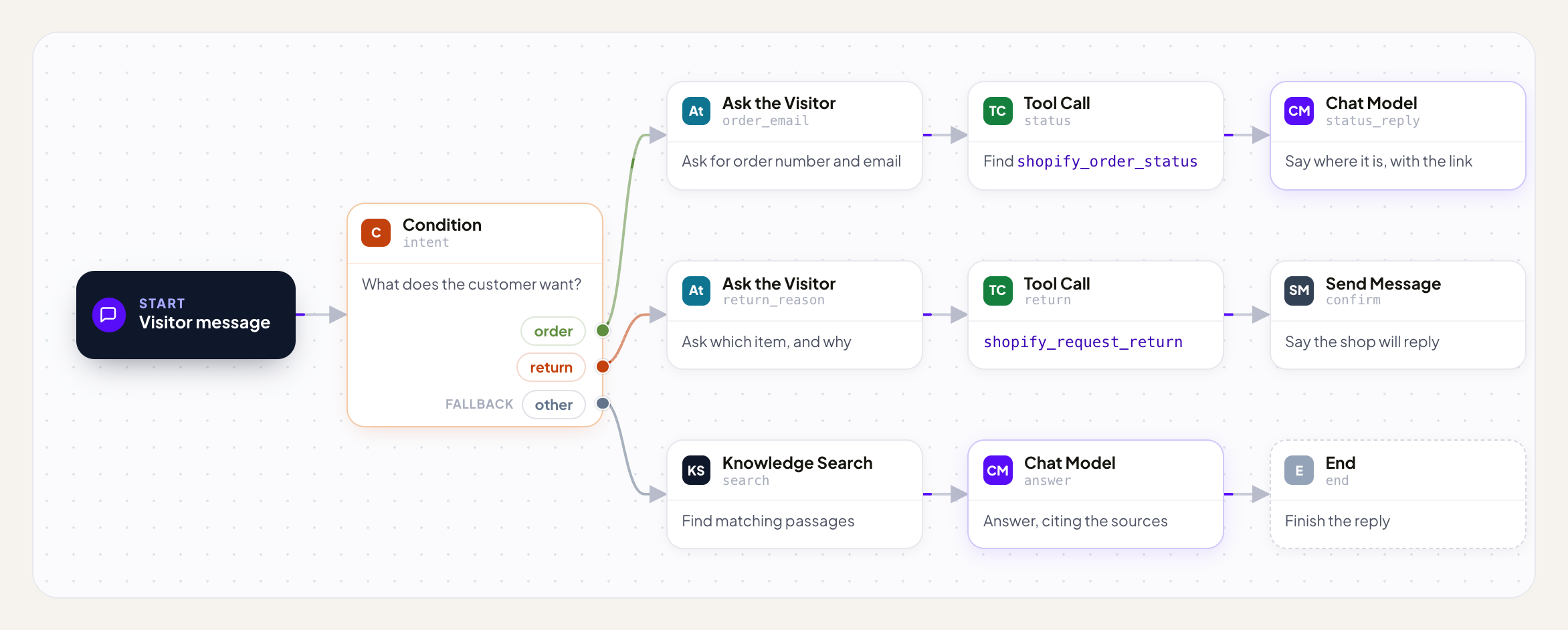
What a chatbot does is shaped by its knowledge base and its workflow. You upload documents, add websites, or write questions and answers to give it the knowledge it needs, then draw a workflow to decide how it handles each conversation.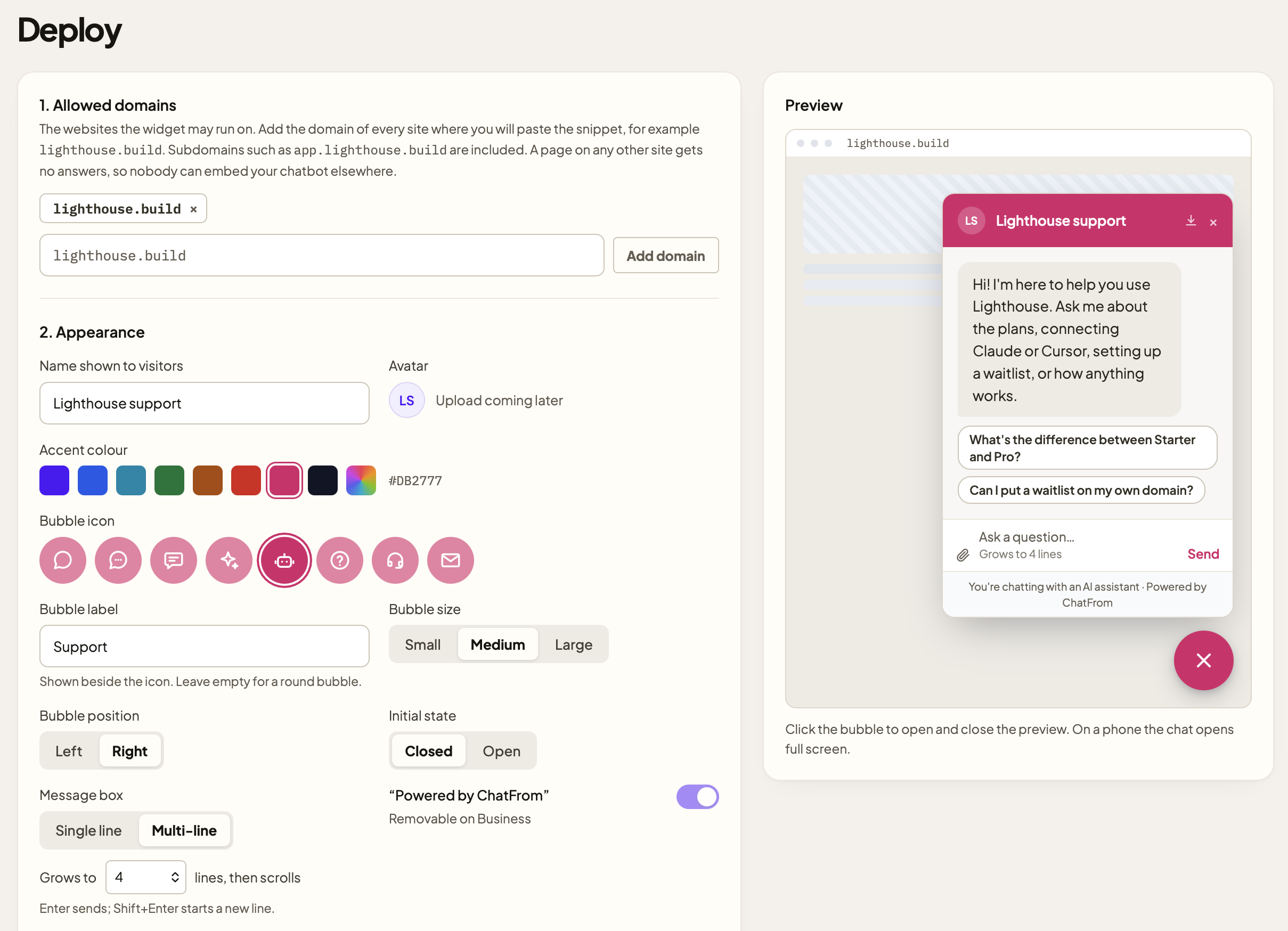
What it can do
Connect it to your tools. ChatFrom works with Shopify, Stripe, Google Sheets, Cal.com and Calendly out of the box, so a chatbot can check an order, manage a subscription, save a lead or book a meeting. You can also connect your own API or MCP server, which opens it up to pretty much any system.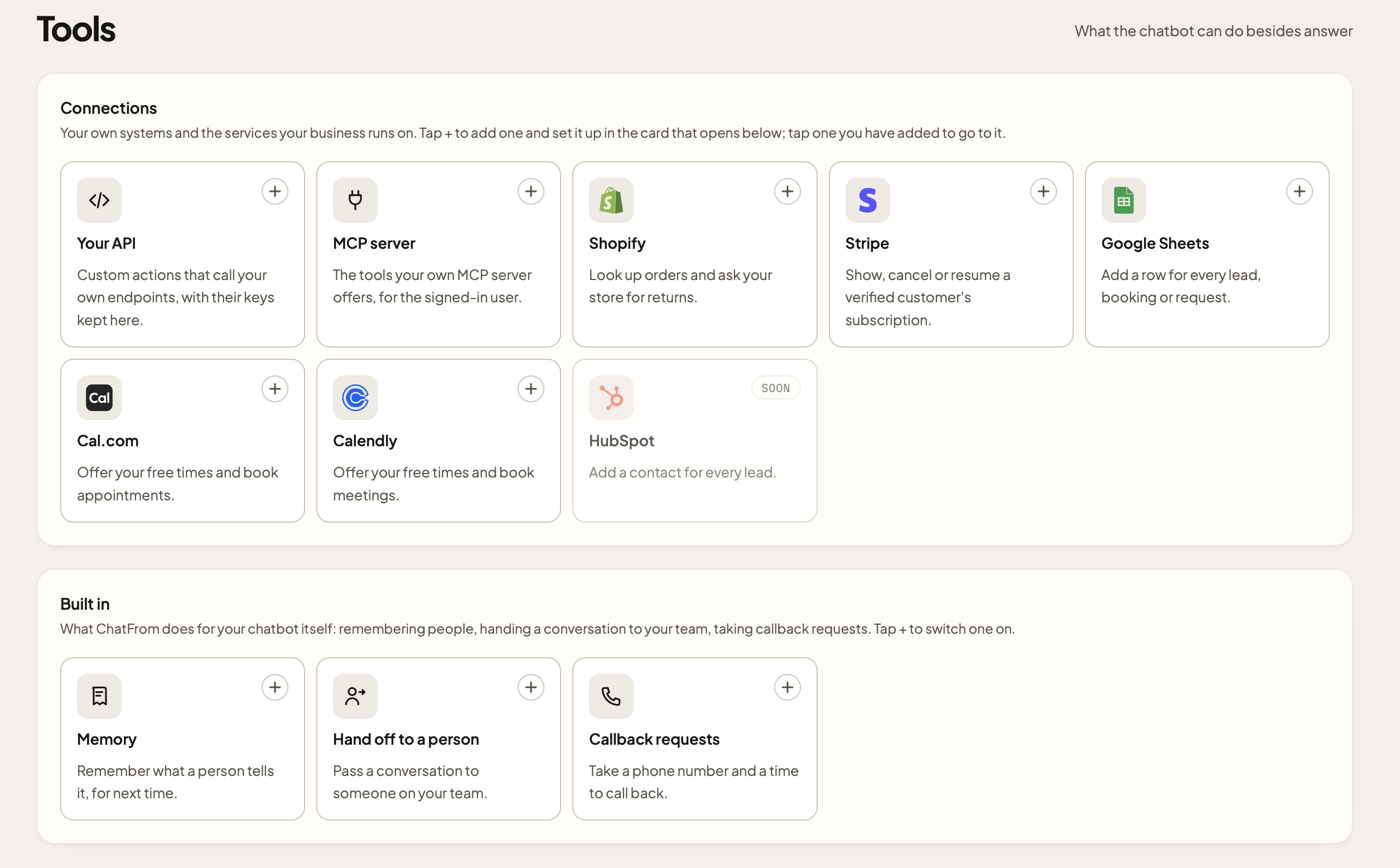
Build workflows. In a visual editor you draw how a conversation should go. A workflow can search the knowledge base, ask the user a question, call an API, take a different path depending on the answer, or hand the conversation to a real person.
Put it where people are. A chatbot can live on your website with one line of code, behind a shareable link, or inside WhatsApp, Telegram, Slack, Discord, Crisp and email. In most of these, people can send it files and photos too.
Make it yours. Pick its tone, language and personality, and choose the AI model it runs on, from OpenAI, Anthropic, Google, Mistral or DeepSeek. It can also remember people between conversations.
Keep improving it. Every conversation is saved, and users can rate answers. You can correct a weak answer, and the fix becomes part of the knowledge base. Analytics and built-in quality tests show how well it's doing.
Costs stay predictable because each plan comes with a monthly allowance of credits, whichever model you choose. There's a free plan, and paid plans start at $29 a month. Data is stored in the EU, and every chat tells people they're talking to an AI.
How it's built
ChatFrom has two parts. The web app is built with Next.js, React and TypeScript. It uses Tailwind CSS for styling, Supabase for the database and sign-in, Stripe for payments and Resend for emails.
The AI engine is a separate open-source service written in Python with FastAPI. It uses LangChain and LangGraph to run conversations and workflows, and Chroma as the vector database. It mixes meaning-based and keyword search to find the right information. Tools connect through MCP, Langfuse traces every answer, and the models run through OpenRouter.
It all runs in Docker on a server and deploys automatically with GitHub Actions. Answer quality is checked with RAGAS and with a set of test questions graded by a separate AI model, where the chatbot scores 9.86 out of 10.
What's next
Next up are syncing knowledge straight from Notion and Google Docs, keeping websites up to date automatically, a HubSpot integration, Google sign-in, team accounts, API access for developers and mobile SDKs, so a chatbot can run inside iOS and Android apps. On the technical side, the engine's storage is moving to managed services so it can scale past a single server.
Try it at chatfrom.io. The engine is open source at github.com/rouzbeh-abadi/chatbot-engine.