The EU AI Act sorts AI systems into risk classes with very different obligations, and its timeline changed in July 2026. Small companies often can't tell which class their tools fall into, and the free checkers available are questionnaires that give indicative answers without showing their reasoning. This assistant lets a company describe its AI tools in plain words, in English or German. It checks each one against the Act in the Act's own order: scope, prohibited practices, high-risk status and transparency duties. It returns a classification in which every step cites the provision it relies on, and turns the result into a list of obligations with deadlines and draft documents.
A company describes an AI tool in plain words, in English or German. Klar checks it against the Act in the Act's own order: scope, prohibited practices, high-risk status, then transparency duties. It asks short key-fact questions when the description leaves something open ("Does the tool rank, score or filter people?").
Each result gives:
A risk class and the company's role (provider, deployer, importer or distributor), with the Annex point and the date the duties start.
A status next to the class: decided, needs more information, or legally ambiguous. When the law doesn't settle the answer, Klar shows both readings and takes the stricter one as a labelled working assumption, instead of guessing.
Every fact tagged as stated, inferred or assumed, so the user can see what the result rests on.
A citation for every step, checked against the legal text before it is shown.
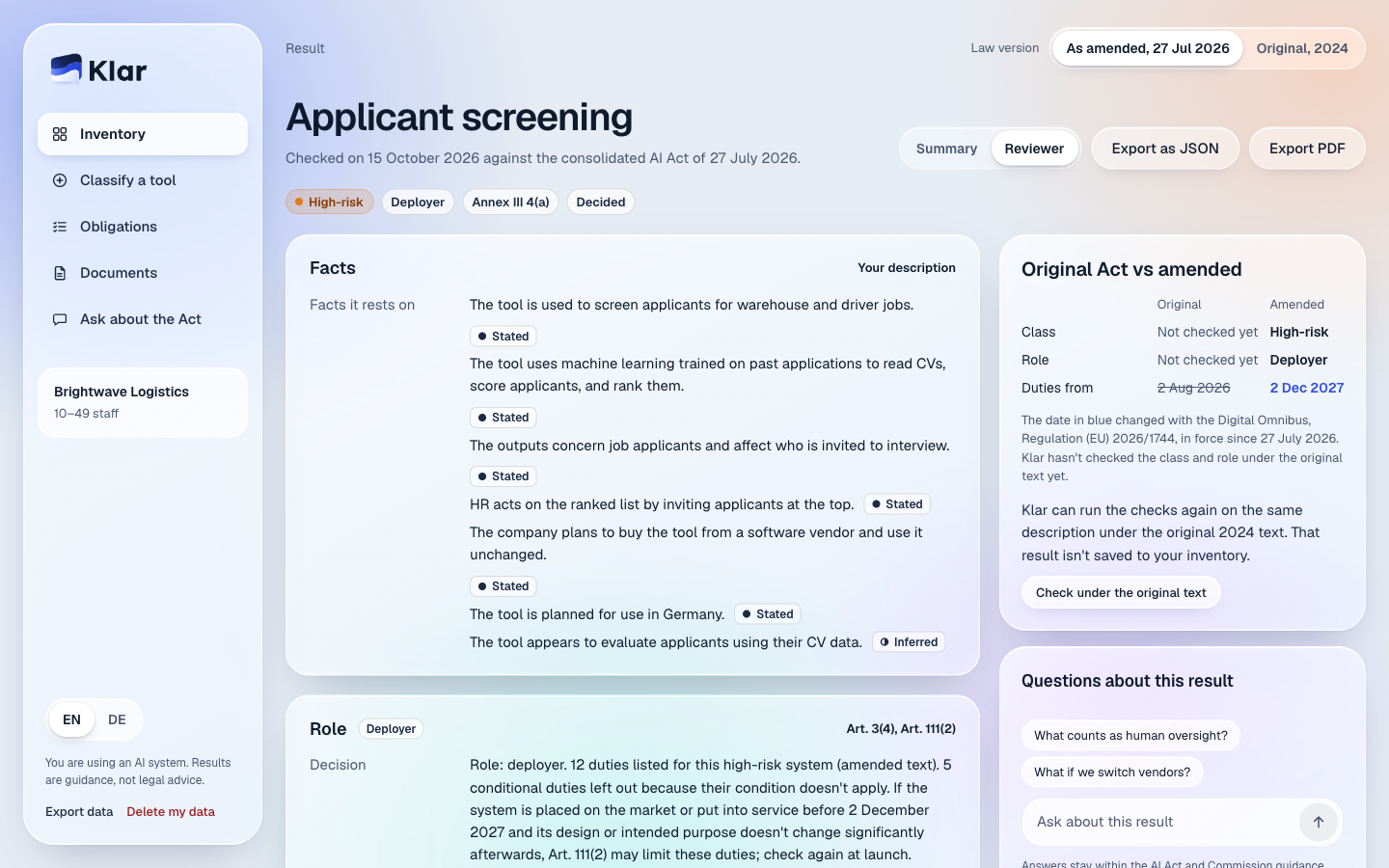 The reviewer view: the facts Klar read from the description, each tagged, and how the result changes between the original 2024 Act and the amended text.
The result then turns into work: an inventory of all the company's AI tools, an obligations checklist with dates, and draft documents such as a human-oversight record or a letter to the vendor. Nothing is invented: a section the user hasn't given information for stays marked "to fill in", and every document is labelled DRAFT.
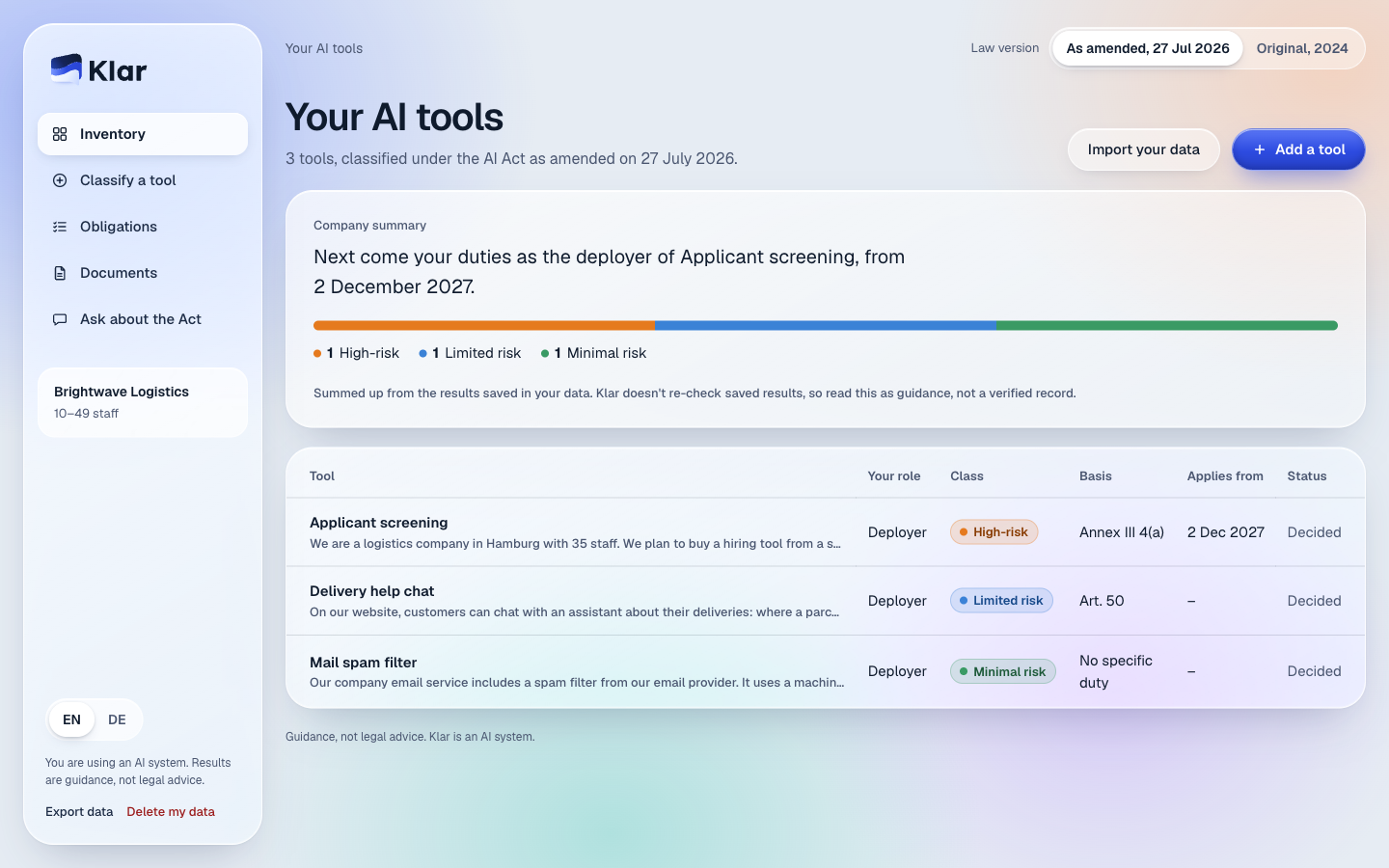 The inventory: one company's three tools.
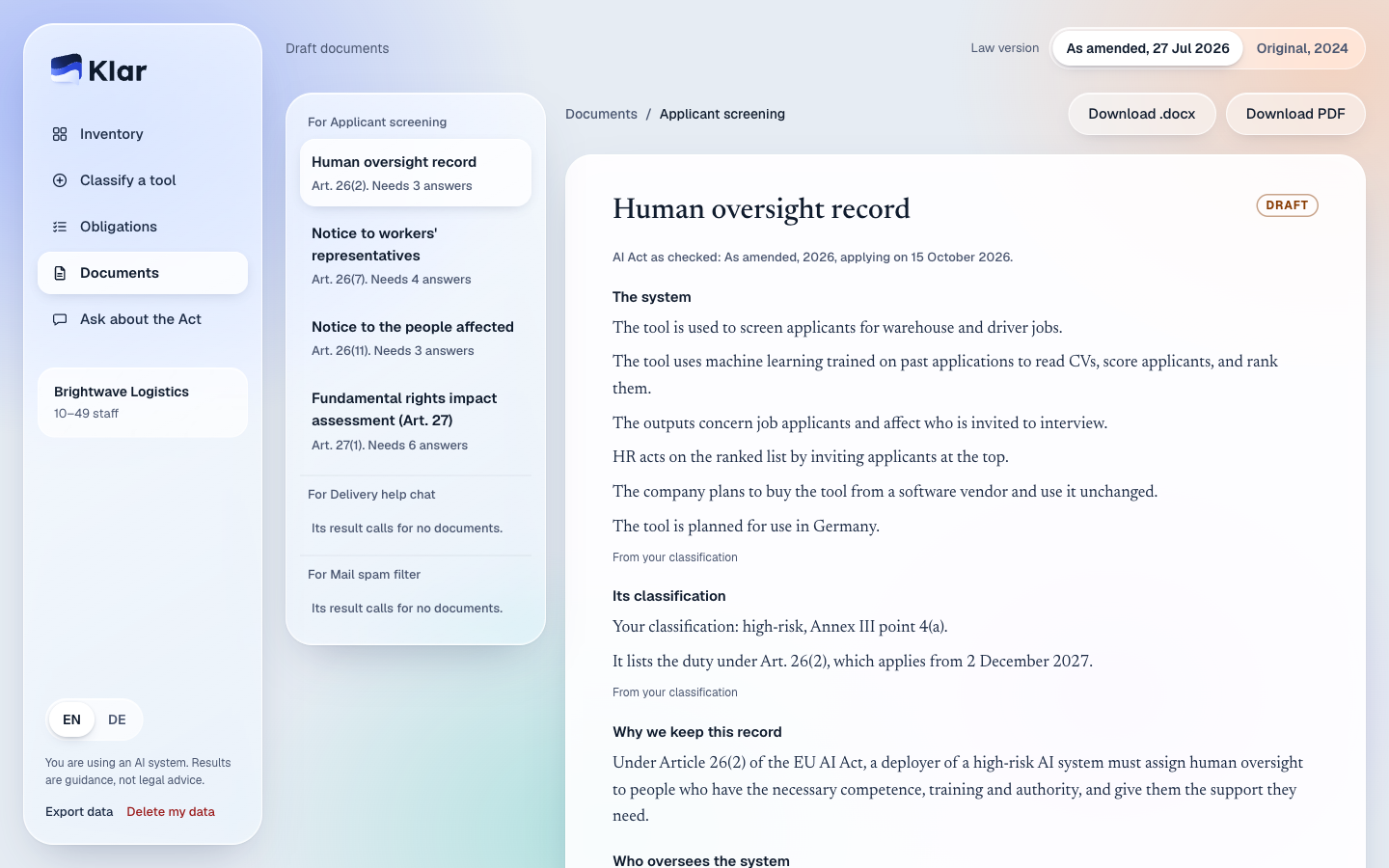 A draft human-oversight record (Art. 26(2)), built from the result. The parts only the company can answer are left open for a guided interview.
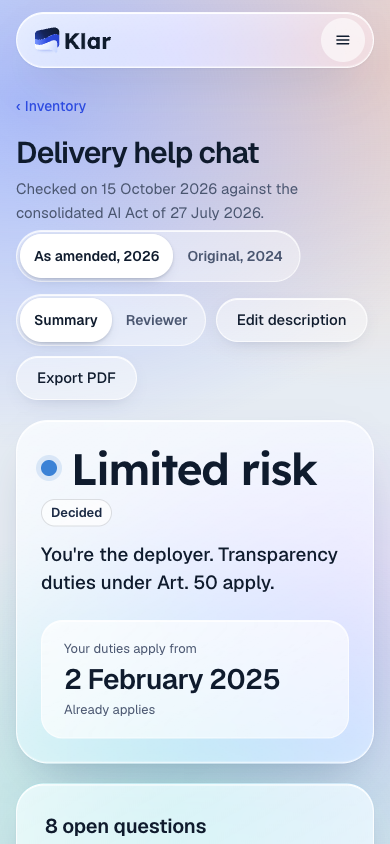 It works on a phone too: a customer-service chat assistant, limited risk under Art. 50.
Klar also works with other AI agents. Its MCP server offers the AI Act lookups and the full classification, so Claude Desktop can classify a tool by itself, on the caller's own API key.
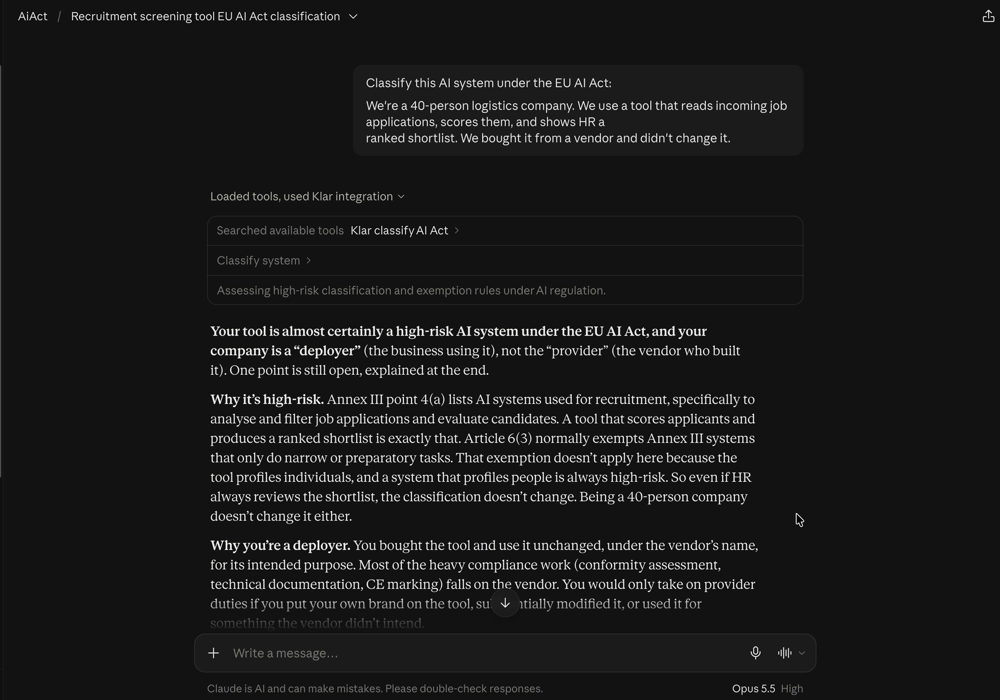 Claude Desktop calling Klar's classification tool for a recruiting tool at a 40-person logistics company.
Guidance, not legal advice. Every result, document and tool answer says so, and names the version of the law it used. High-risk, prohibited and ambiguous results recommend a legal review.
Private by default. No account is needed. Data is visible only to its owner, "Delete my data" removes everything at once, and inactive data is deleted after 30 days.
Open about its limits. The labels had no external legal review, and the high-risk results rest on the Commission's draft guidelines of May 2026. Both are stated in the app and the README.