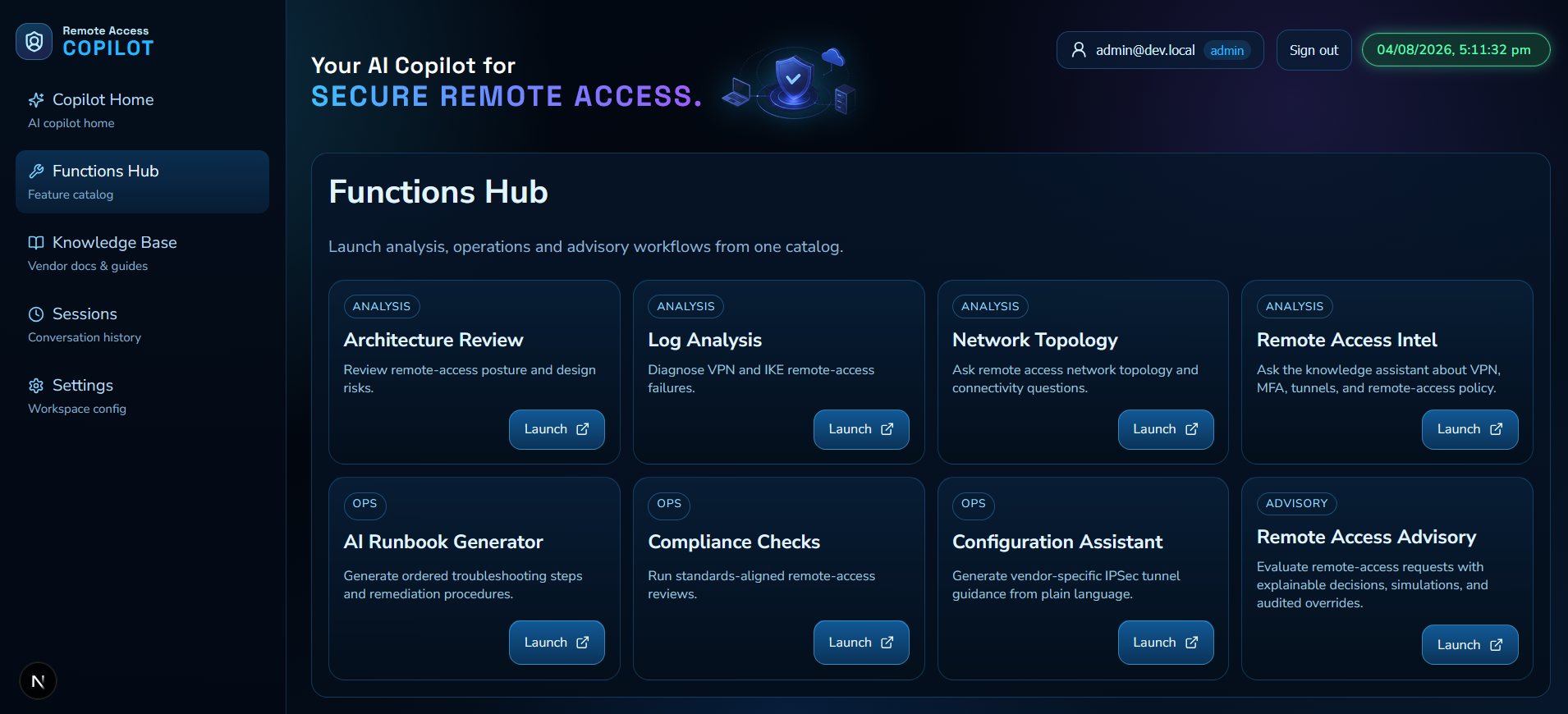
This project combines a RAG-powered knowledge assistant with an AI agent automation system. A strong attention to architecture (using SDD), security, monitoring, testing and comprehensive documentation instead of focusing only on AI features makes this application close to production-ready. Use of LangGraph for several stateful workflows, hybrid retrieval, layered security controls, and operational tooling makes this app built for real-world use.
System Architecture: The combination of FastAPI, Next.js, PostgreSQL with pgvector, LangGraph, RBAC (Role Based Access Control), monitoring, and security creates a complete and well-integrated platform. On top of that, the clear separation between agents, retrieval, security, prompts, and monitoring makes the codebase easier to maintain and scale.
Advanced Use of LangGraph: It uses conditional routing, checkpointing, and graph-based orchestration with three separate state graphs: a troubleshooting workflow, an approval workflow, and a planner-led multi-agent workflow.
Strong Retrieval Design: It uses hybrid retrieval pipeline, which combines dense retrieval, BM25, Reciprocal Rank Fusion, cross-encoder re-ranking, query expansion, and NDCG evaluation. (Further improved after project review: Increase embed_batch_size to reduce HTTP round-trips and parallelize embedding calls using ThreadPoolExecutor. Large document ingestion runs as a background task with a dedicated DB connection and relaxed timeout).
Security: The security is treated as a core part of this project design. Security design includes Presidio-based PII redaction, fail-closed guardrails, configuration checks, RBAC, JWT authentication, tenant isolation, audit logs, and dedicated security documentation.
Testing: Testing coverage includes unit, integration, security, performance, evaluation and load tests with hundreds of functions. To mitigate AI-specific risks some valuable tests for prompt-injection and ownership-spoofing are also covered.
Production-grade Observability: It uses Prometheus, Grafana, OpenTelemetry, LangSmith, trace middleware and detailed metrics. On top of that tracking confidence scores, latency, and token usage adds real operational value.
Documentation: Last but certainly not the least, the README and operational guides in detail explain deployment, rollback, monitoring, security, and day-to-day operations.
Remote Access Copilot helps network and security operators manage, troubleshoot, and harden enterprise remote-access infrastructure (VPN, IPSec, ZTNA, MFA, and related policy). It solves the problem that remote-access incidents and design reviews are slow and error-prone when evidence is scattered across logs, vendor docs, topology, and policy — operators otherwise rely on tribal knowledge and manual correlation. The platform works by combining natural-language prompts with grounded retrieval (RAG over curated vendor and security corpora), LangGraph agent workflows, and human-in-the-loop tools: users ask a question or launch a guided action, the system retrieves and reasons over relevant evidence, then returns explainable recommendations, runbooks, configs, or compliance findings that operators can act on with oversight (simulations, queues, and audited overrides).
Conversational copiloting — Ask about VPN, MFA, tunnels, posture, and policy from a single home surface.
Architecture & compliance review — Score remote-access posture, surface critical findings, and check configs against CIS, NIST, ISO 27001, Zero Trust, and NSA VPN guidance.
Intelligent troubleshooting — Turn incident statements into ranked root-cause hypotheses, confidence scores, evidence, and ordered checks; analyze VPN/IKE logs for Phase-1 / Phase-2 diagnosis.
Operations & advisory — Generate vendor-specific IPSec guidance, AI runbooks, and policy-hardened configs; evaluate access requests with explainable decisions and audited overrides.
Knowledge Base — Grounded Q&A over curated vendor documentation (Cisco, Fortinet, Microsoft, OpenVPN, WireGuard, Palo Alto, Juniper, AWS, Google Cloud, NCP) with citations.
Ask or launch — Start with a natural-language prompt or a guided Architecture Review / Troubleshooting action.
Grounded analysis — Assistants retrieve evidence from remote-access intel, logs, topology, vendor docs, and policy context.
Act with oversight — Open deeper tools from the Functions Hub for queues, simulations, compliance checks, or audited overrides.